Accessible design, code and content
Navigating without a mouse, enlarging text or completing a form with a screen reader: these are practical requirements for design and development.
For a new site, we build accessibility into the navigation, design system and content model. For an existing site, we assess key journeys and shared components, then plan the work around what prevents people from using it and which changes will improve the most pages.
We update interfaces and the code behind them, work through changes with your subject specialists and support your editors. The work can cover corporate websites, customer portals, bookings and multi-step applications, with third-party services and documents included in the agreed scope.
Where Austrian websites fall short on accessibility
Austria’s 2025 accessibility monitoring programme included simplified checks of 349 public-sector websites. The FFG’s interim report identifies specific problems with readability and interface controls:
- 74%
- of the websites checked failed the minimum text contrast criterion.
- 79%
- had controls that did not adequately expose their names, roles or states to assistive technology.
These findings cover a sample of public-sector websites, not all Austrian websites. The simplified checks assessed 14 selected WCAG criteria.
Low contrast makes text harder to read. A control without an accessible name or state leaves screen reader users without essential information. We address both the design and the code, so people can read the content and understand what controls do without having to see the screen.
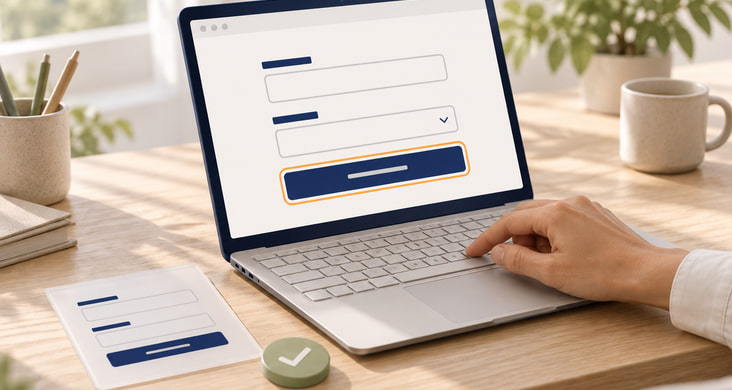
Form feedback that helps.
A red outline alone does not explain what is missing. A useful error message identifies the field, explains what to change and is associated with the input so a screen reader can announce it.
Leave the fields empty and select “Check entries”. The links in the error summary take you to the fields that need attention. A visible focus outline helps you keep your place when using the keyboard.
Where we focus the work
We review navigation, content and complete tasks using a keyboard, a screen reader and enlarged text.
Navigation and orientation
Menus need to open, work and close using a keyboard. We examine focus order, headings and page regions, including mobile menus and how people find their place after navigating to another page.
Forms and application journeys
Labels, input guidance and error messages are designed together. In multi-step processes, we check that entries are retained, requests for corrections make sense and moving to the next step is understandable without a mouse.
Design and shared components
Contrast, enlarged text and narrow screens matter alongside the behaviour of accordions, dialogs and tables. Improvements to shared components carry through to the pages that use them.
Content and editorial tools
Editors need appropriate fields and clear guidance for headings, link text and image descriptions. We identify any additional work needed for video, downloadable documents and third-party services.
Turning findings into working changes
You receive a prioritised list of affected components, proposed changes and checks to verify them. We can carry out the work or collaborate with your existing developers.
- Review key pages, shared components and complete user journeys
- Agree a WCAG-based assessment target, with a defined scope and coverage of third-party systems
- Combine automated checks with manual keyboard and screen reader testing
- Update design, templates, forms, JavaScript and editorial content
- Retest changes and work through findings with external accessibility specialists
- Prepare evidence for independent certification where it is part of the brief
Accessibility law in Austria
The applicable rules depend on who provides a digital service and what it does. An online shop and a public-sector website fall under different legal frameworks.
The BaFG: covered consumer products and services
Austria’s Barrierefreiheitsgesetz (BaFG), implementing the European Accessibility Act, has applied since 28 June 2025. It covers services including online shops, consumer banking and digital passenger transport ticketing. Identification and payment must also be accessible where covered.
Not every company website falls within its scope. Microenterprises providing services are exempt if they employ fewer than ten people and have annual turnover or an annual balance sheet total of no more than €2 million. Transitional provisions cover specific cases; older websites are not automatically exempt.
The WZG: public-sector websites and apps
The Web-Zugänglichkeits-Gesetz (WZG) applies to federal government websites and apps, including those of qualifying public bodies. Corresponding provincial laws apply at regional level. Obligations include technical accessibility requirements, a published and regularly updated accessibility statement, and a way to report barriers.
The BGStG: protection against discrimination
Austria’s Bundes-Behindertengleichstellungsgesetz (BGStG) protects against disability discrimination, which can include digital barriers. It operates alongside the BaFG. Conciliation proceedings are handled by the regional offices of the Sozialministeriumservice.
We turn the requirements agreed with your team into specific work for designers, developers and editors. WCAG provides a technical basis, alongside the relevant EN 301 549 requirements where applicable. The project records the assessment scope, version and conformance level.
Test the task, make the change, test it again
We start by agreeing specific tasks with you: finding a product, changing a registration or completing an application. We also map the components used across the site. This shows which changes will benefit many pages and which journeys need individual attention.
Automated checks catch some issues. Whether a menu is understandable or an error message helps someone finish a form also requires manual assessment. Designers, developers and the relevant business teams work through the findings together, followed by another round of checks.
Balázs Vizi, our lead frontend developer and accessibility specialist, has been part of rudybohrer since March 2016. His role brings interface design and implementation together, including keyboard interaction, focus management and clear feedback.
For our WACA projects, we work with Werner Rosenberger of the Hilfsgemeinschaft der Blinden und Sehschwachen Österreichs, an Austrian organisation supporting blind and visually impaired people. We carry out the agreed implementation work. Certification is handled independently through WACA and its certification body, TÜV Austria. The audit reports record the scope, award level and identified deviations.
Keeping accessibility in the release process
A new menu, another form, a software update: each can affect how people use the site.
We include repeatable checks in quality assurance and document the journeys to test before a release. We also work with editors on guidance for new content and documents. The testing scope reflects the site and our agreed responsibilities.
If certification is part of your brief, we prepare the site for independent assessment and help address the findings. A certificate covers the scope and version assessed; subsequent changes still need to be checked.
Accessibility in practice
Our journal takes a closer look at the work on navigation, forms and application journeys. Read about the client projects, our collaboration with external specialists and the independent audit findings.