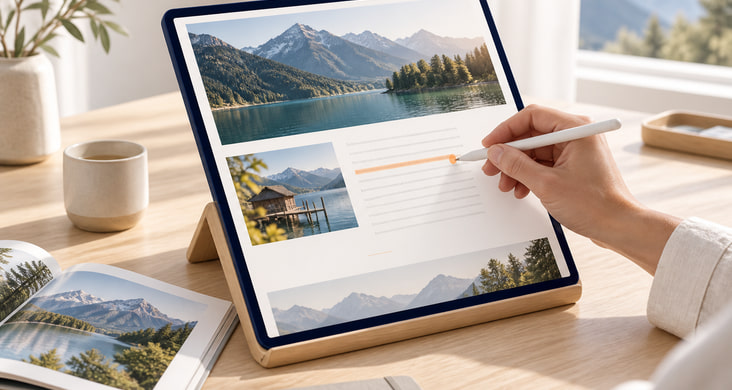
Edit pages in context. Review changes together.
In Neos, editors work on the page itself, with the text in its intended context.
They can update headings and paragraphs, add content blocks and move them into place. A sidebar holds the remaining fields. We build those blocks around your content—services, locations or contacts, for example—and define where each type can be used.
Changes start in a personal workspace. Shared workspaces let colleagues review work together before it goes live. Editors can publish a single element, a page or a group of changes. Roles determine who can edit, review and publish.

Edit content where it appears
Neos lets editors change and format text directly on the page. This official Neos 9.1 example shows a blog post being edited.
Product view: © Neos Project
Neos: official inline-editing example
Where Neos makes sense
Neos is a good fit for teams that update their websites regularly and manage content for several markets or brands.
Corporate and brand websites
One Neos installation can serve several websites and domains, each with its own design and editorial responsibilities. Shared components and brand-specific content help new pages stay consistent with the right visual identity.
Languages and regional editions
Content Dimensions manage variations of the same content. A German-language page might need different information for Austria and Germany. We define what is shared, what changes locally and which version appears when a translation is unavailable.
Campaigns and editorial launches
Teams can prepare and review a set of pages in a workspace while the existing website remains live. That is useful when copy, images and links all need to change at an agreed time.
Websites connected to business data
Custom integrations can bring in product information from a PIM, media from a DAM or data from other business systems. We establish which system owns each dataset and what editors can add in Neos.
Neos development, backed by Flow experience
Neos runs on the PHP framework Flow. We have delivered numerous projects with Flow and draw on that experience when developing Neos features, connecting existing systems and maintaining the application.
- Content architecture and design: Navigation, page types and reusable content blocks, modelled as Neos Node Types. We work with your editorial team to shape the editing experience.
- Development and integrations: Custom rendering with Fusion, extensions built on the Flow PHP framework, and connections to search, forms and existing business systems.
- Editorial workflows and languages: Workspaces, roles and publishing permissions, alongside Content Dimensions and rules for shared and local content.
- SEO, performance and accessibility: Metadata, canonical URLs, language alternatives, sitemaps and redirects. We test loading times and accessibility against the actual pages and content.
- Migration, updates and operations: Content migration, custom extension updates, staging tests and coordinated deployment. We work with your IT team and hosting provider on PHP, databases, backups, monitoring and maintenance.
Moving an existing website to Neos 9
Neos 9 introduced a new foundation for content storage. Its Event Sourced Content Repository records changes as events, from which the current content state is built. This also underpins workspaces and content variants. For an existing website, the move therefore involves more than replacing the CMS version.
For a Neos 8 to 9 upgrade, we review content types, language and regional settings, Fusion components and custom PHP code. Automated migration tools help with the transition, but project-specific changes and a trial data migration still need planning. We agree the release and rollback procedure before the production switch.
From the TYPO3 community to an independent CMS
Neos began in the TYPO3 community in 2006 and has been developed independently since 2015. It is a separate CMS, not a newer version of TYPO3. Its source code is public under the GPL, with no CMS licence fee. Development, hosting and maintenance are budgeted for the project. You choose the infrastructure independently and can hand the system over to another team.
Neos in practice and related services
The right CMS depends on how your editors work, what they publish and which systems are already in place. We compare suitable options and explain what the differences mean for your project.
- win2dayA newsletter CMS with Acoustic and dynamic jackpot headers
- Craft CMSMatrix blocks and flexible content models
- TYPO3Workspaces, complex websites and custom extensions
- Headless CMS adviceAn integrated website or a separate content layer
- Maintenance and supportTaking over and developing an existing website
- AccessibilityNavigation, forms and accessible web applications